
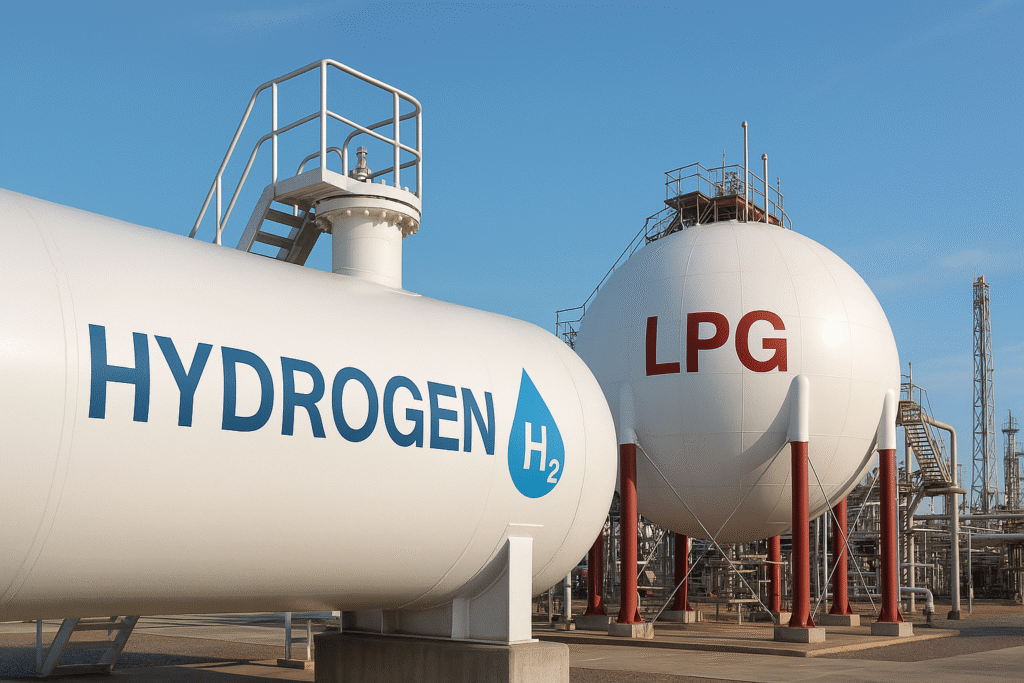
As the United States accelerates toward a net-zero emissions future, hydrogen is emerging as a cornerstone of the national energy strategy. However, transitioning from Liquefied Petroleum Gas (LPG) infrastructure to hydrogen systems is not a plug-and-play upgrade—it requires careful engineering, smart automation, and robust safety controls. With the Department of Energy (DOE) prioritizing hydrogen hubs and clean fuel innovation, engineering leaders must now bridge legacy energy infrastructure with next-generation solutions.
LPG vs. Hydrogen: Understanding the Infrastructure Shift
While both are gaseous fuels, LPG and hydrogen differ drastically in their physical and chemical characteristics:
- Hydrogen is lighter and more diffusive, requiring materials that prevent permeability and embrittlement.
- Storage vessels for hydrogen must handle much higher pressures or cryogenic temperatures compared to LPG bullet tanks.
- Detection systems for hydrogen must be far more sensitive, as it is odorless, colorless, and burns with an invisible flame.
- Distribution systems, including pipelines, valves, and compressors, need to be re-engineered for hydrogen’s unique behavior.
These factors make the transition not just a matter of substitution—but of total system redesign.
Smart Safety: SCADA, AI, and Process Safety Management
To support the safe rollout of hydrogen infrastructure, modern control systems and predictive technologies are essential.
- SCADA and PLCs provide centralized real-time monitoring of tank pressures, leak sensors, and emergency shutdown systems across hydrogen plants.
- AI-driven fault prediction models can identify micro-leaks, valve wear, and abnormal temperature gradients long before human operators notice.
- Smart PSM (Process Safety Management) frameworks, incorporating risk registers, ERP dashboards, and HAZOP-based automation, reduce the likelihood of catastrophic failure.
Adar Chowdhury, an engineer with 12+ years in LPG terminal development and SCADA-integrated safety systems, is uniquely positioned to guide this transition. His expertise in integrating CMMS, SAP PM, and ISO/NFPA standards into gas infrastructure projects is directly applicable to emerging hydrogen hubs.
Engineering the Transition: Adar’s Experience and the U.S. Opportunity
Throughout his career, Adar has overseen:
- High-pressure gas installation and commissioning
- SCADA-linked leak detection and fire protection systems
- ERP-integrated maintenance tracking and compliance reporting
- Pre-Startup Safety Reviews (PSSR) and Emergency Response Plans (ERP) in complex industrial environments
This hands-on experience makes him an invaluable asset in scaling hydrogen systems safely. His work ensures that hydrogen rollout in the U.S. doesn’t compromise safety in pursuit of sustainability.
In fact, bridging the gap between LPG and hydrogen isn’t just about infrastructure—it’s about knowledge transfer, smart automation, and policy-aligned execution.
A Net-Zero Future Needs Smart Transitions
The U.S. hydrogen economy is expanding—with bipartisan funding, DOE pilot projects, and public-private partnerships at full throttle. But to succeed, this transition must be grounded in the lessons learned from legacy fuels like LPG.
Through the combined application of AI, SCADA, and modern safety engineering, and through the leadership of experts like Adar Chowdhury, the U.S. can make its hydrogen dreams not just achievable—but reliably safe and globally competitive.